
Net Promoter Score (NPS) in contact centres: why it doesn’t tell the full story
Net Promoter Score (NPS) is one of the most widely used measures of customer experience.
It is simple to implement, easy to communicate and provides a quick indication of how customers feel about a service or organisation. For many contact centres, it has become a widely accepted benchmark.
However, despite its popularity, NPS does not always tell you what is actually happening within a contact centre, and when too much weight is placed on the score in isolation, it can lead to decisions that fail to address the real drivers of performance.
What is NPS and why is it so widely used?
Net Promoter Score (NPS) measures customer sentiment by asking a single question:
“How likely are you to recommend us to others?”
Responses are grouped into promoters, passives and detractors, creating a single score that can be tracked over time and reported easily at every level of the organisation.
For contact centre leaders, NPS offers a straightforward way to measure customer experience, providing a consistent benchmark and a metric that translates well into board-level reporting.
That simplicity is part of what has made it so widely adopted, but it is also where some of its limitations begin to show.
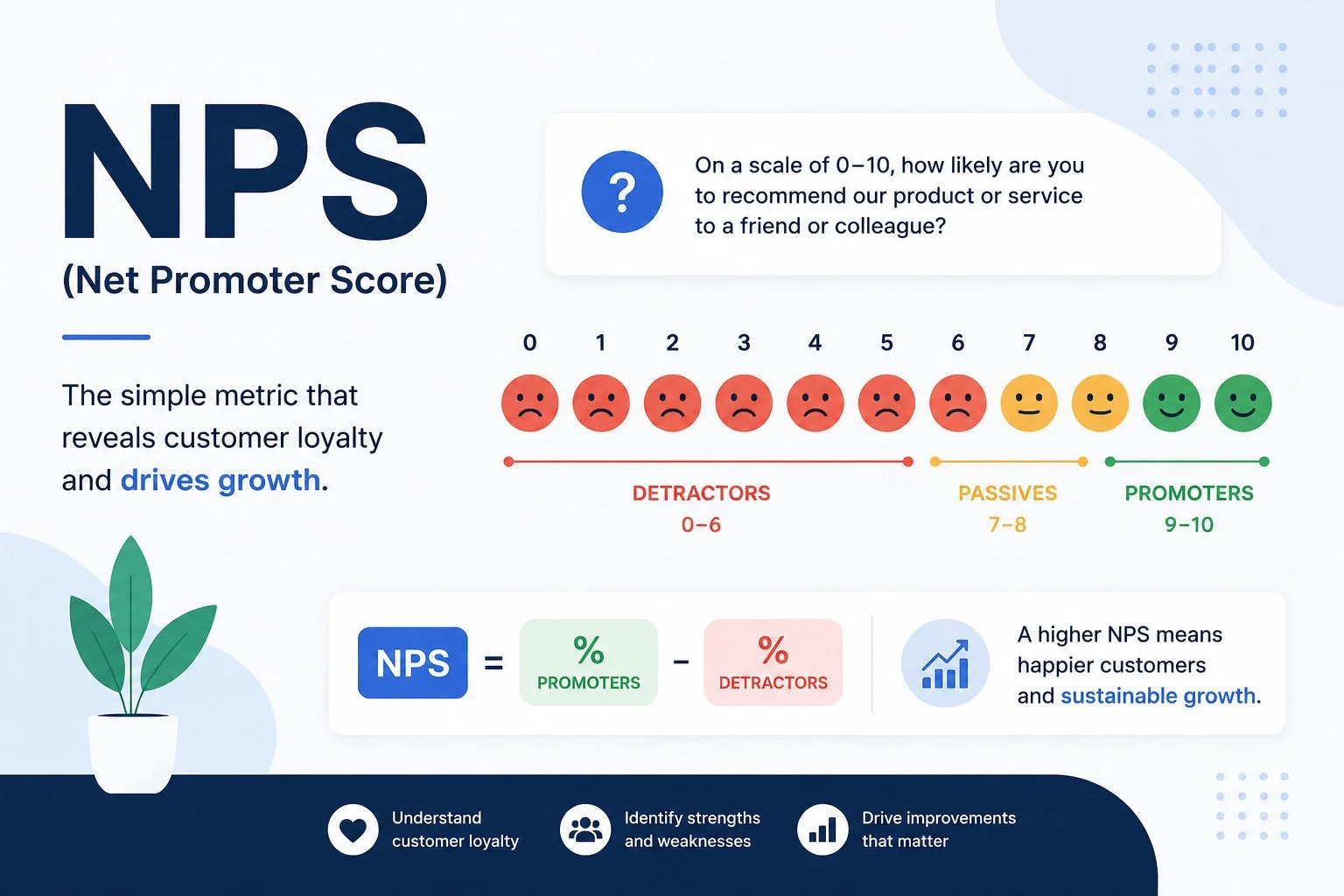
NPS Explanation
The limitation of NPS: a snapshot, not the full picture
NPS captures customer sentiment at a single moment in time, often immediately following an interaction.
In many cases, that interaction has taken place because something has not gone as expected, which means the feedback captured can be disproportionately influenced by that single experience rather than reflecting the overall relationship a customer has with an organisation.
It is entirely possible for a long-standing customer with years of positive experience to register as a detractor following one poor interaction, and when viewed in isolation, this can create a skewed picture of performance.
Why relying on NPS alone can lead to the wrong decisions
One of the most common challenges is not the metric itself, but how it is used in practice.
Organisations often respond to fluctuations in NPS without fully understanding what is driving the change. A drop in score can be interpreted as a broader decline in customer experience, when in reality it may be linked to a specific point of friction within the operation.
This could be a breakdown in a particular process, an issue within a specific customer journey, or a temporary operational pressure such as increased demand or delays.
Without that context, there is a risk of focusing on improving the number rather than addressing the underlying issue.
This is often where an independent operational audit can help validate what the data is really telling you and bring clarity to where improvement efforts should be focused.
NPS does not explain why customers feel the way they do
While NPS provides a clear indication of how customers feel, it does not explain why they feel that way.
Without that understanding, it becomes much harder to identify the root causes of dissatisfaction or to prioritise improvement activity in a meaningful way.
This is where many customer experience programmes begin to lose momentum, with effort directed towards shifting a metric rather than resolving the operational issues that are shaping customer perception.
A more effective approach: combining NPS with operational insight
NPS can play an important role in measuring customer experience, but it is most effective when it is considered alongside a broader set of operational measures.
When used in combination with operational data, it becomes far more meaningful and, importantly, far more actionable.
This typically includes measures such as first contact resolution, repeat contact, queue performance and wait times, as well as a clear understanding of contact drivers and why customers are getting in touch in the first place.
Looking at NPS alongside these measures helps to build a more complete and balanced picture of both sentiment and performance, enabling organisations to move beyond how customers feel and towards understanding what is driving that experience and where improvement efforts should be focused.
From measurement to meaningful improvement
The role of NPS should not be to act as a standalone indicator of performance, but to act as a starting point for deeper analysis and discussion.
When organisations combine customer sentiment with operational insight, they are better placed to identify the root causes of dissatisfaction, prioritise improvement activity and focus effort where it will have the greatest impact.
This approach also creates a stronger link between customer experience and operational performance, supporting more consistent and measurable improvements over time.
NPS as part of a broader customer experience strategy
Net Promoter Score remains a useful and widely recognised metric within contact centres.
However, on its own, it rarely tells the full story.
For contact centre leaders, the priority should not be improving the score in isolation, but developing a clearer understanding of the operational reality that sits behind it.
That is where meaningful and sustainable improvement begins.
If you’d like help to fully understand what’s driving your NPS our CX Audit can give you an objective view and a roadmap to address any issues
